

Outlook to 2100 using five greenhouse gas emission scenarios, derived from five socio-economic scenarios and five levels of radiative forcing.
Contents
- Summary for policymakers
- Introduction
- Sections
- Introduction
- Current status and trends
- Long-term climate and development futures
- Near-term responses in a changing climate
Greenhouse gas emissions scenarios
These have been formed from a combination of one of five ‘shared socio-economic pathways’ and one of five levels of ‘radiative forcing’ (see below).
- Very low: SSP1-1.9*
- Low: SSP1-2.6
- Intermediate: SSP2-4.5
- High: SSP3-7.0
- Very high: SSP5-8.5
* SSP: shared socio-economic pathway. 1.9: level of radiative forcing.
SSP1 is used twice and SSP4 is not used.
Shared socio-economic pathways
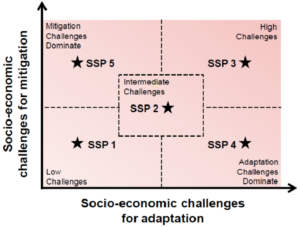
A ‘shared socio-economic pathway’ is a scenario based on a set of socio-economic assumptions.
Key drivers: socio-economic challenges for adaptation versus mitigation.
- SSP1: Sustainability.
- SSP2: Middle of the Road.
- SSP3: Regional Rivalry.
- SSP4: Inequality.
- SSP5: Fossil-fueled Development.
Levels of radiative forcing
‘Radiative forcing’ is the difference between the earth’s incoming and outgoing energy, measured in watts per square metre in 2100.
- Very low: 1.9
- Low: 2.6
- Intermediate: 4.5
- High: 7.0
- Very high: 8.5